Promoting tree regeneration in
Sahel: why is it so complicated and
where do we go from here?

           Denis Gautier & Régis Peltier
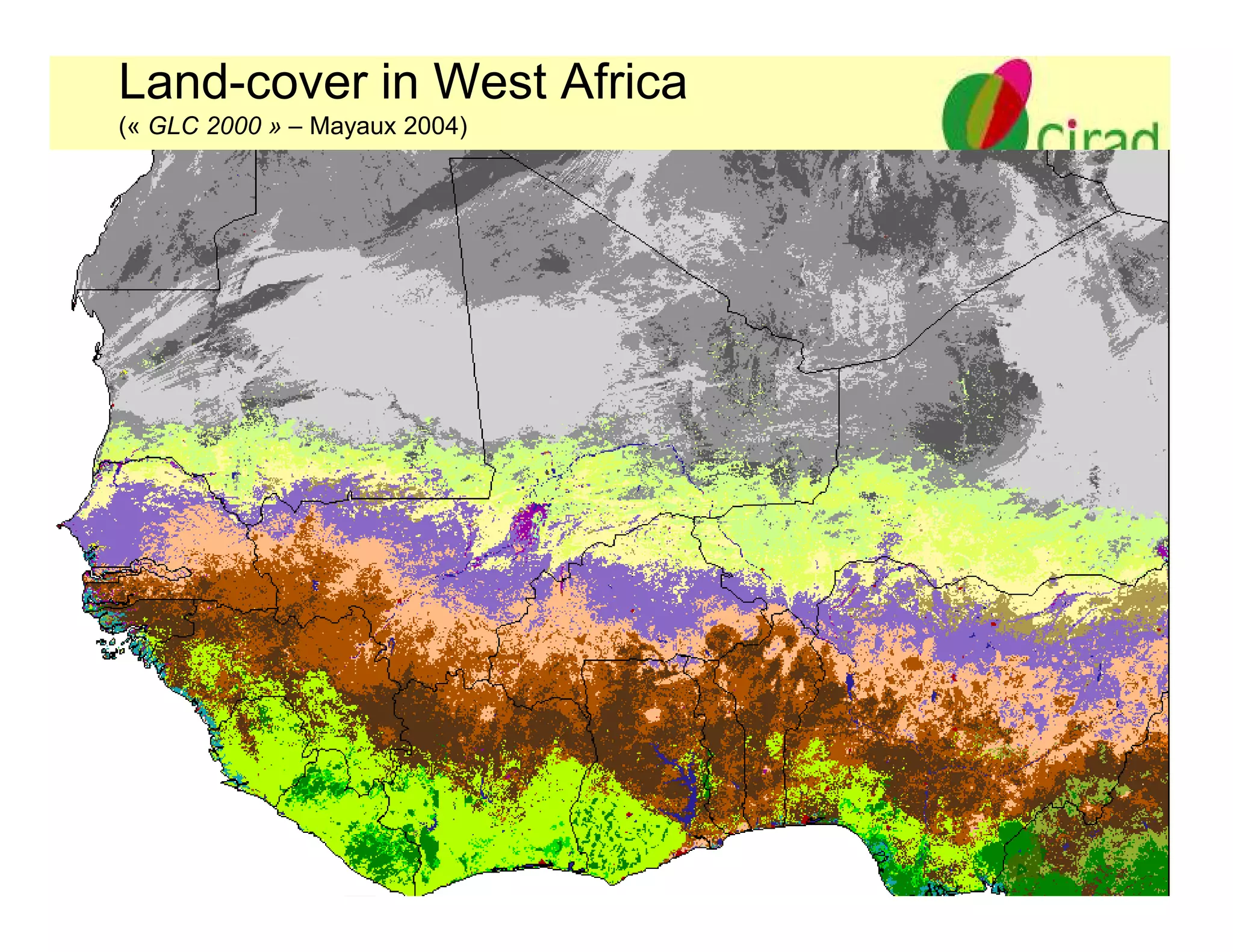
Land-cover in West Africa
(« GLC 2000 » – Mayaux 2004)
Main issues
The history of Sahelian forestry is strongly linked
to dramatic environmental and political events
The international organizations have used these
events to reform the way to manage forests in
Sahel
Almost 40 years after the first dramatic droughts,
forestry paradigms have changed at least three
times
However, little progress has been registered in
terms of forest and tree regeneration, while the
wood demand is increasing
Have the participative and integrative approach
of community forestry failed?
The co-evolution of the environmental
and political contexts and the forestry reforms
    During the colonial period and the first part of
    the post-colonial period: a centralized, restrictive
    and coercive forestry
    70’s:
       1973: first huge drought
      “Green barrier” to “fight” the desertification
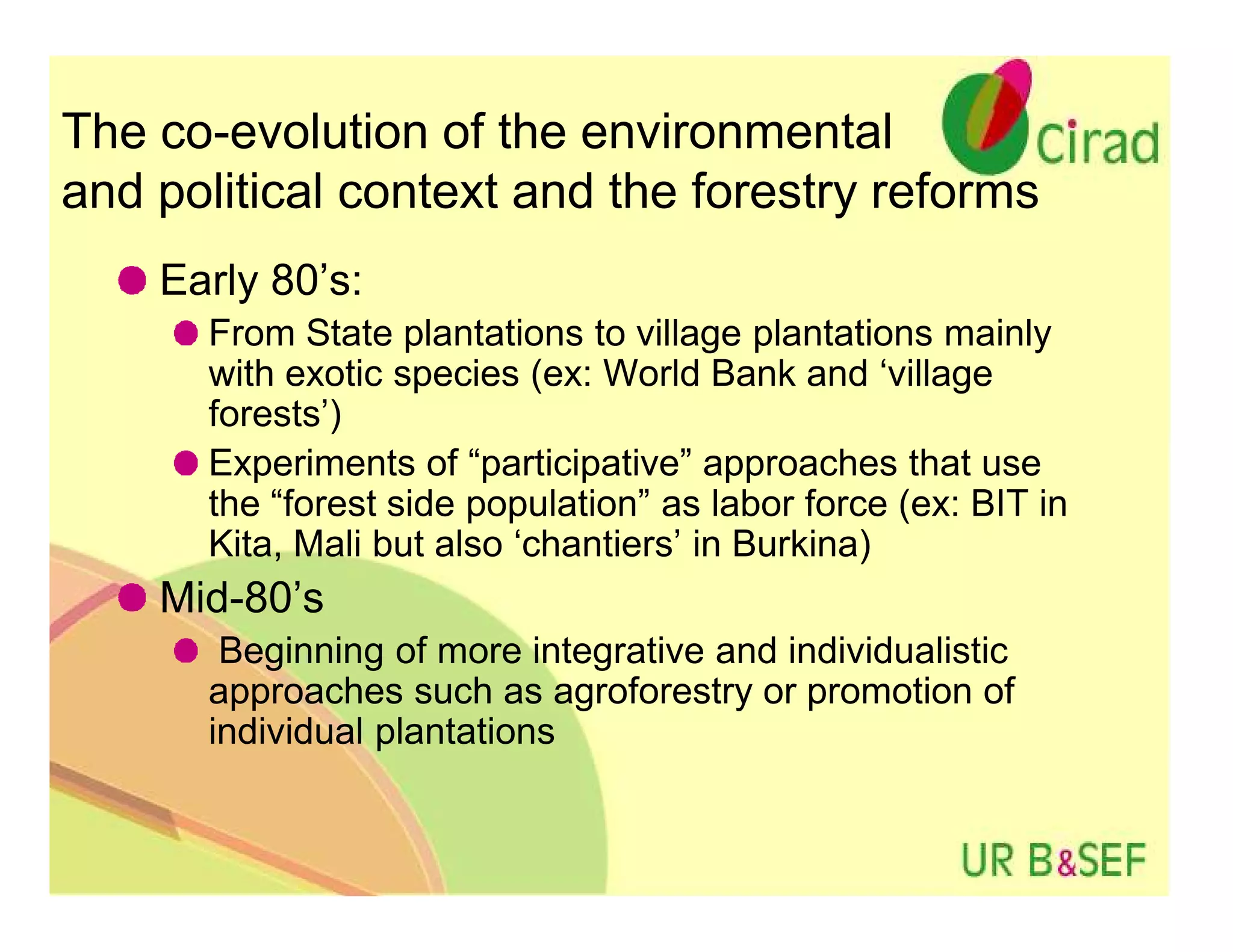
      State plantations of exotic species with expected high
      productivity
      But also: Creation of the CILSS that try to lead the
      Central administrations to better involve local people
      in the forest management
State plantations of exotic species with
expected high productivity
The co-evolution of the environmental
and political context and the forestry reforms
    Early 80’s:
      From State plantations to village plantations mainly
      with exotic species (ex: World Bank and ‘village
      forests’)
      Experiments of “participative” approaches that use
      the “forest side population” as labor force (ex: BIT in
      Kita, Mali but also ‘chantiers’ in Burkina)
    Mid-80’s
       Beginning of more integrative and individualistic
      approaches such as agroforestry or promotion of
      individual plantations
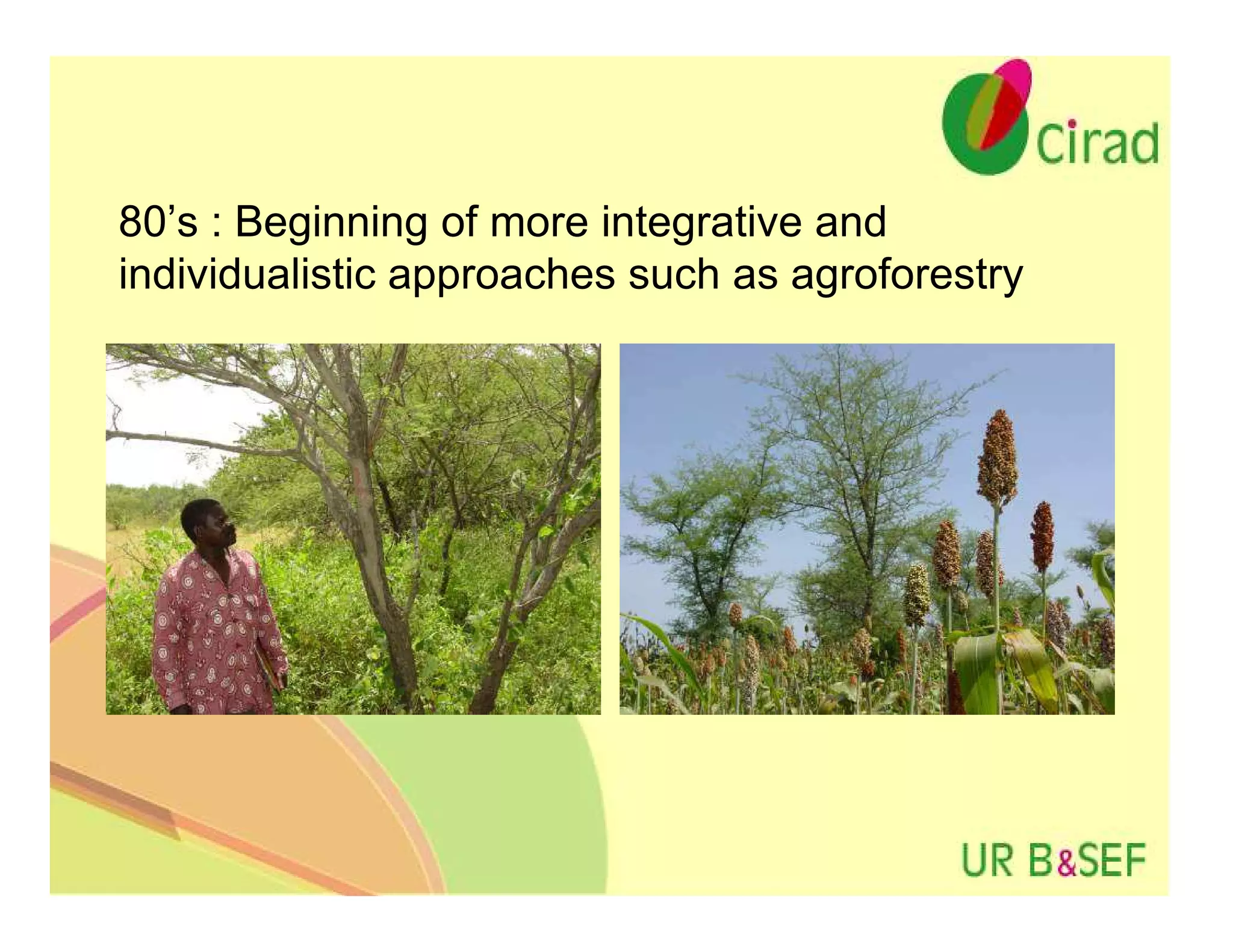
80’s : Beginning of more integrative and
individualistic approaches such as agroforestry
The co-evolution of the environmental
and political context and the forestry reforms
    End 80’s - Early 90’s:
      Structural Adjustment plans
      Less State but not necessarily better State:
      decreased control on the field and increase of
      corruption
      Rural people are seeking more democracy and
      participative ways of managing forest resources
      Beginning of a ‘revolution’, which lead people to
      recapture their bush and to ‘plant the seeds’ of
      decentralization
The co-evolution of the environmental
and political context and the forestry reforms
    90’s
      Launch of decentralization processes
      Change of paradigm in forestry with the
      transfer of forest management to local people
      (+/- within the framework of decentralization)
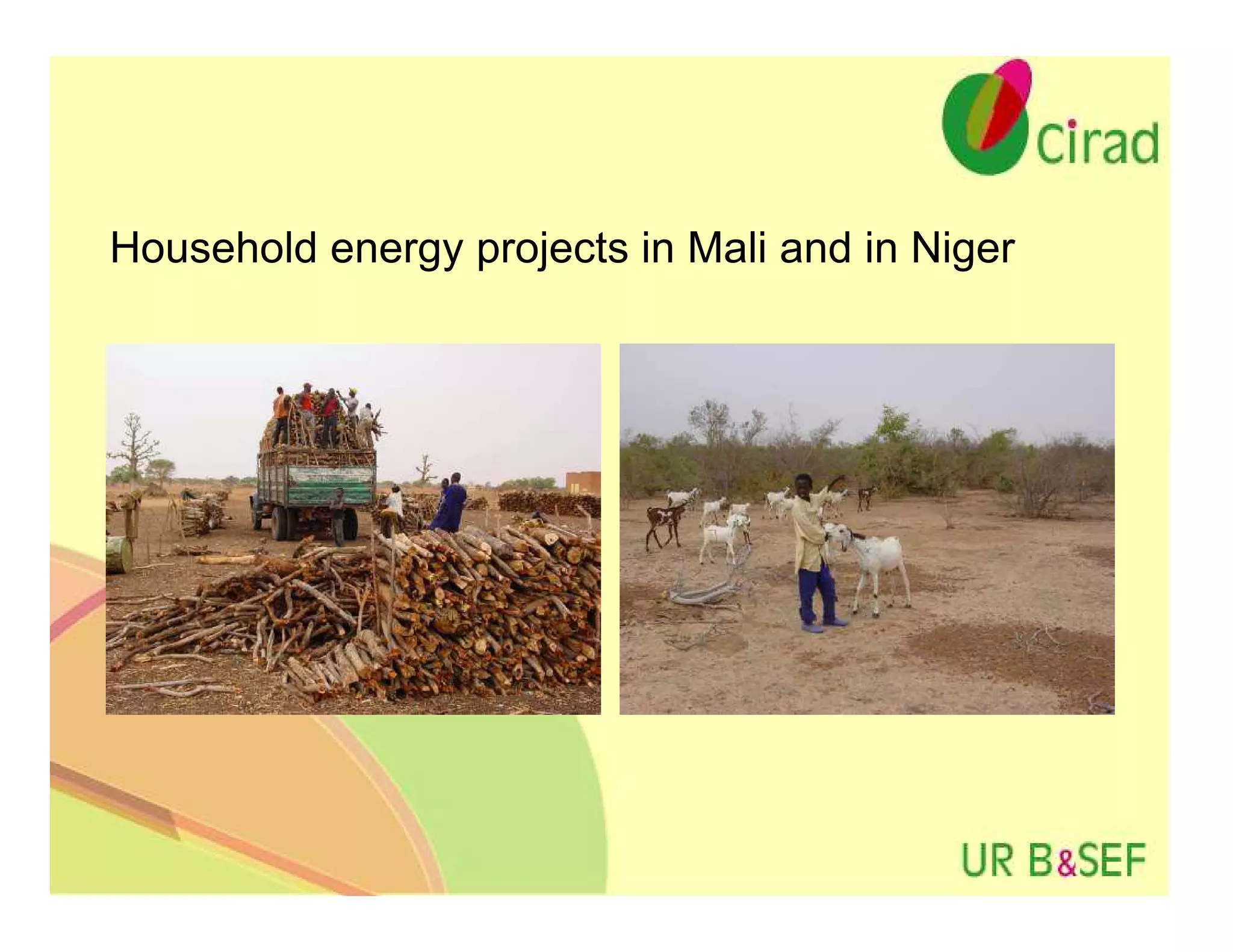
      Household energy projects in Mali and in
      Niger
      ‘Chantiers’ around the State forests in Burkina
      ‘community forestry’ in Senegal, Gambia, etc.
Household energy projects in Mali and in Niger
Key scholars in paradigms’ change

   Thomson’s proposals in 80’s
     Giving more power to autonomous local
     government
     Privatization of tree tenure and common
     property resource
Key scholars in paradigms’ change

   Bertrand et al and Kerkof proposals in
   mid-80’s
     Transfer of management authority to local
     people (professional organizations)
     Reform of forest fiscal system to promote
     sustainable management of the commons
     (differential taxation)
     Regulation and control of collective property
     exploitation
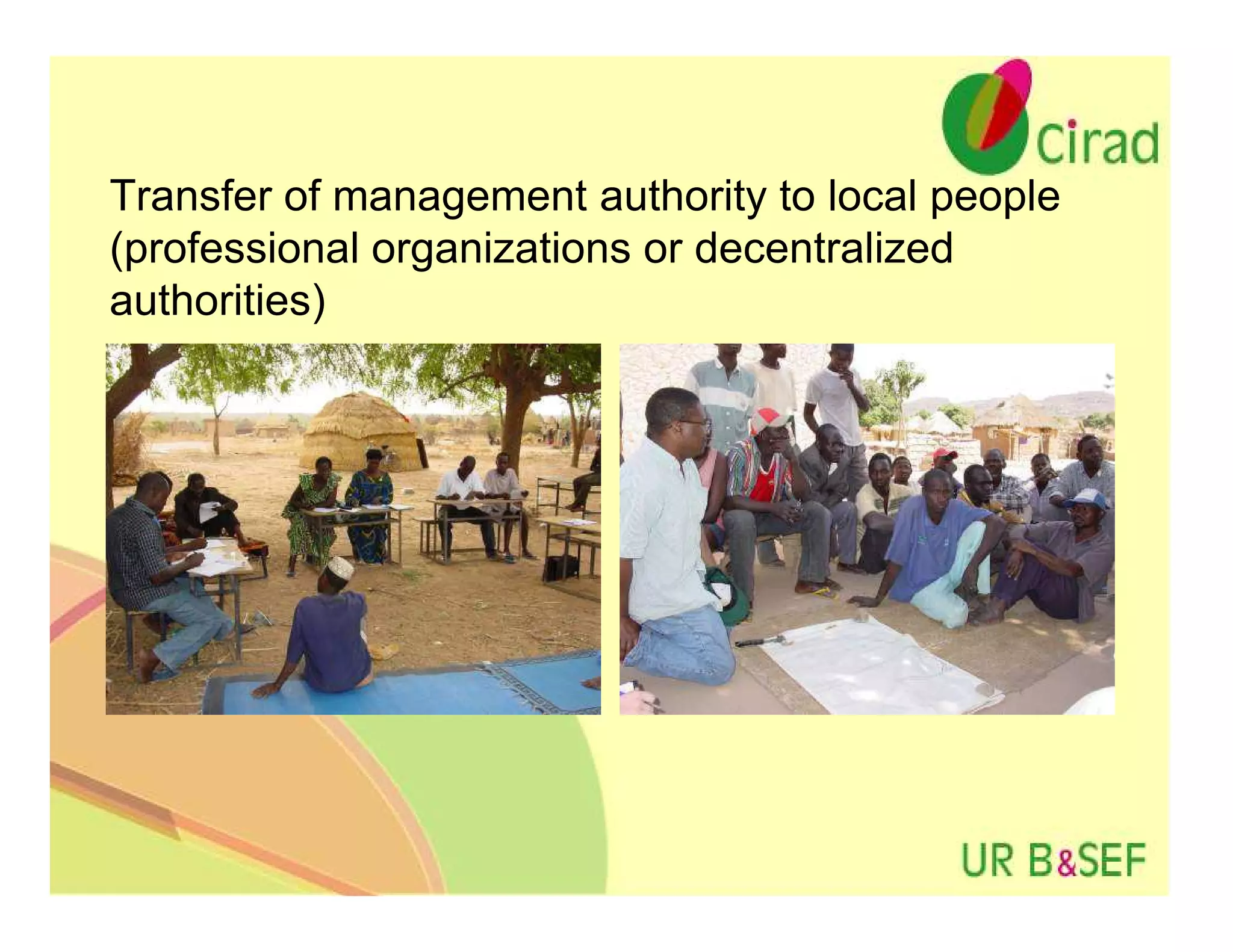
Transfer of management authority to local people
(professional organizations or decentralized
authorities)
Key scholars in paradigms’ change

   Ribot’s proposals in 90’s
     Empowerment of local authorities as a
     conditionality to sustainable management of
     ‘la brousse’
     Accountability of the involved institutions to
     empower local democracy
Few of these changes
 in Sahelian forest paradigms
     has lead local people
to regenerate trees and forests
Some explanations (1)
  Technical points:
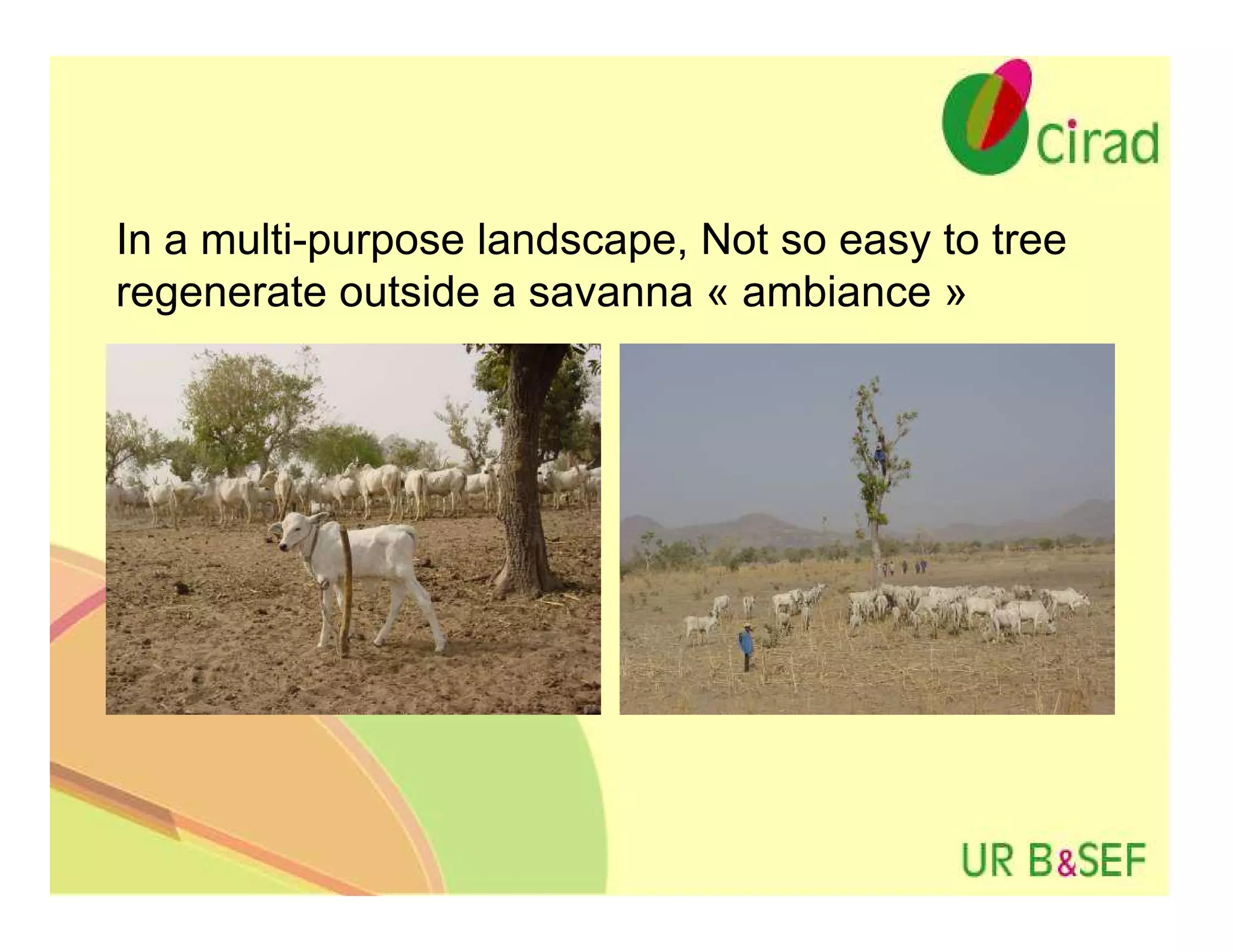
    In a multi-purpose landscape, it is not easy to
    spare a young tree from livestock or
    ploughshare
    Some species are not so easy to regenerate
    outside a forest (or long fallow) “ambiance”
In a multi-purpose landscape, Not so easy to tree
regenerate outside a savanna « ambiance »
Some explanations (2)
  Social points:
    Until farmers and herders perceive resource
    scarcities and view them as gravely
    threatening, they manage the forest in a
    ‘passive’ way
    Scientists were wrong about the forest
    resource scarcity in Sahel, and they have
    maybe discouraged donors
      Cf Arnold explanation on the importance of
      parklands and fallows in wood supply
      Savannas are more resilient than expected
Some explanations (3)
  Institutional and Political points:
    Sahelian officials have inherited and
    internalized the French colonial
    administration’s antipathy to non-government
    sponsored collective action
    The actual forest administrations ambivalent
    about resistance to decentralization
    processes and an attraction for nasty fines
Some explanations (3’)
  Institutional and Political points:
    Local people know the limit of voluntary action
    in preserving unregulated common property
    resources and attempt informal privatization
    People personally know free-riders when
    investment in resource preservation is
    promoted
    The inflation of institutions governing the
    commons generate power conflicts that are
    profitable to free-riders
This has worked!!!!
This has worked!
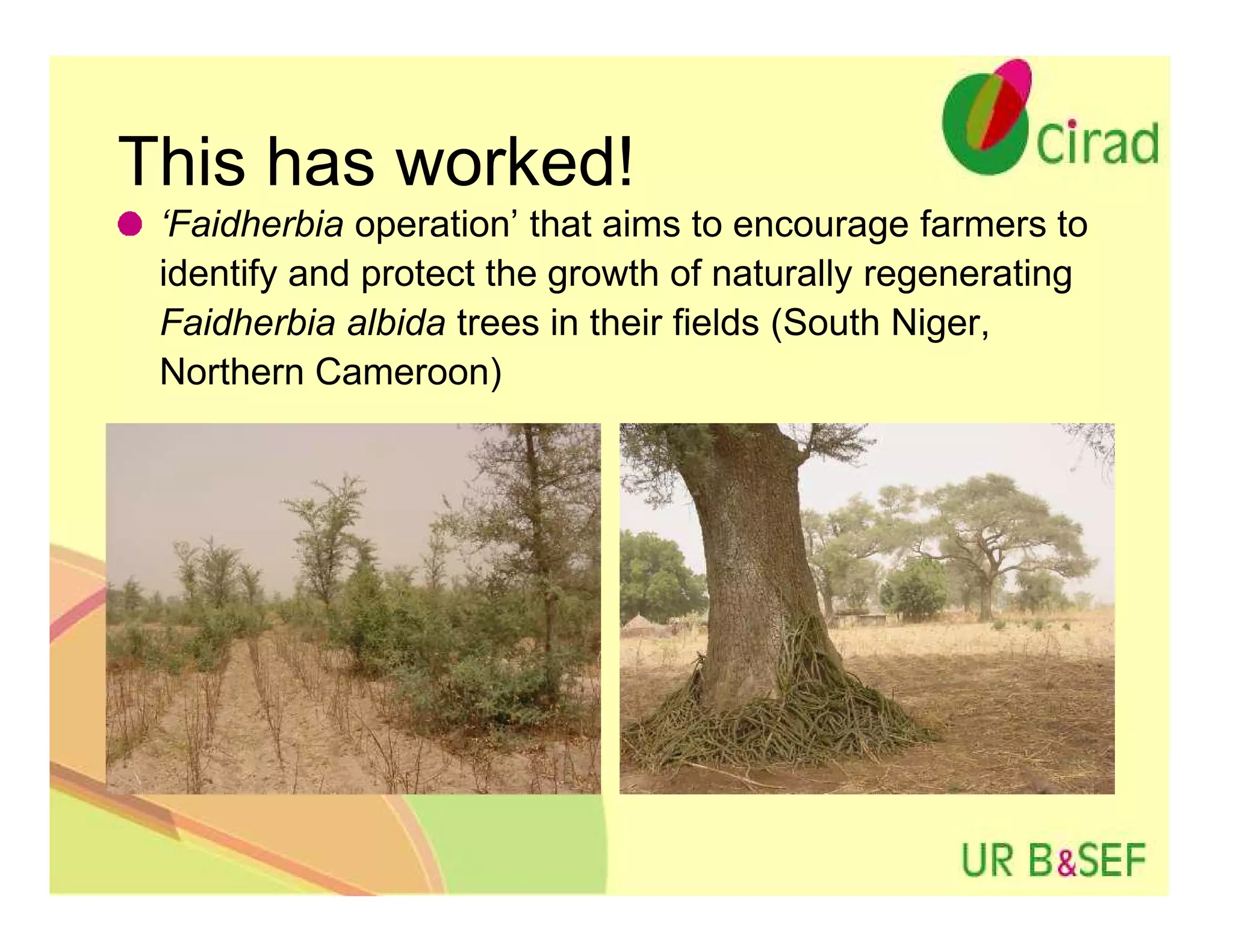
 ‘Faidherbia operation’ that aims to encourage farmers to
 identify and protect the growth of naturally regenerating
 Faidherbia albida trees in their fields (South Niger,
 Northern Cameroon)
This has worked!
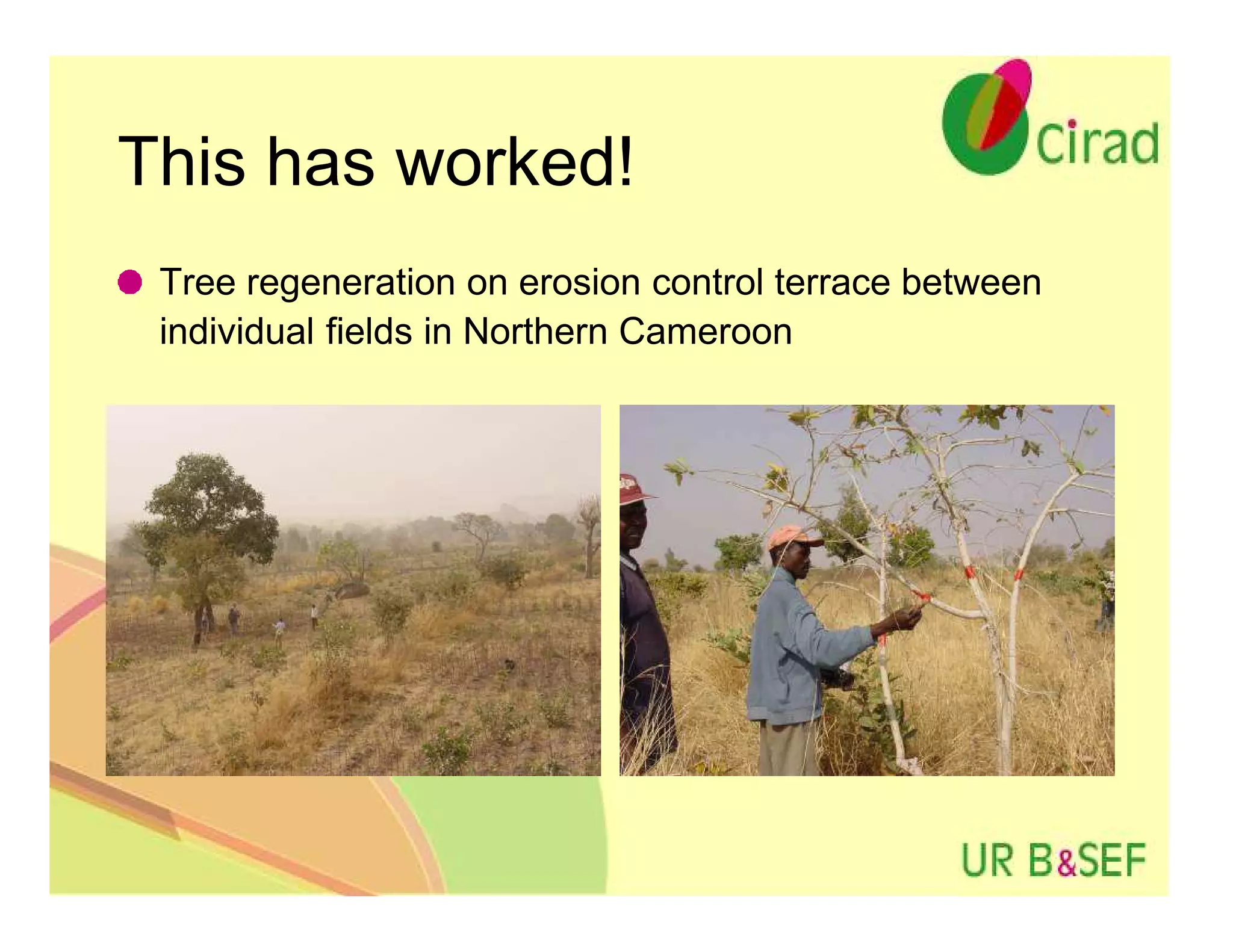
 Tree regeneration on erosion control terrace between
 individual fields in Northern Cameroon
This has worked!
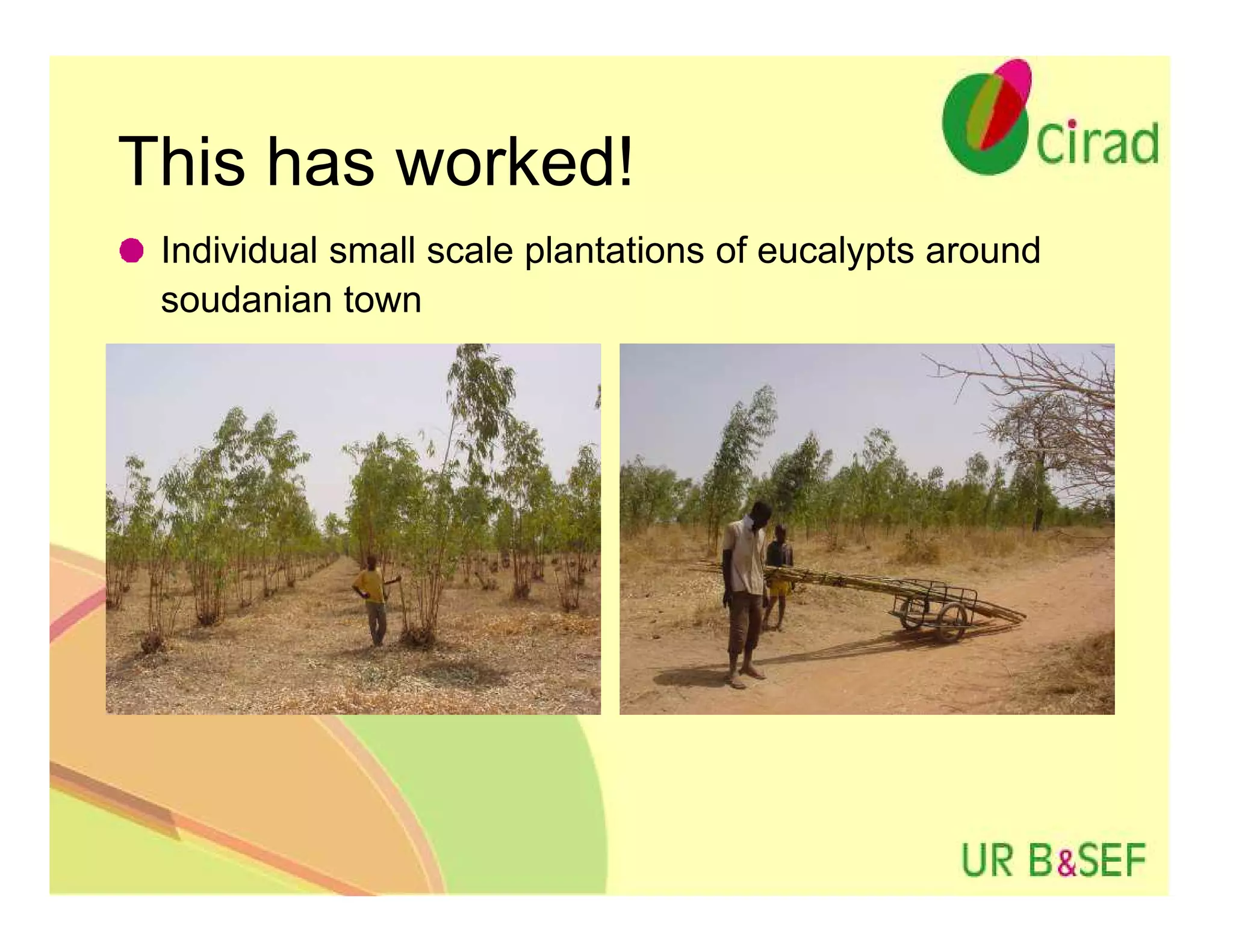
 Individual small scale plantations of eucalypts around
 soudanian town
This has worked!
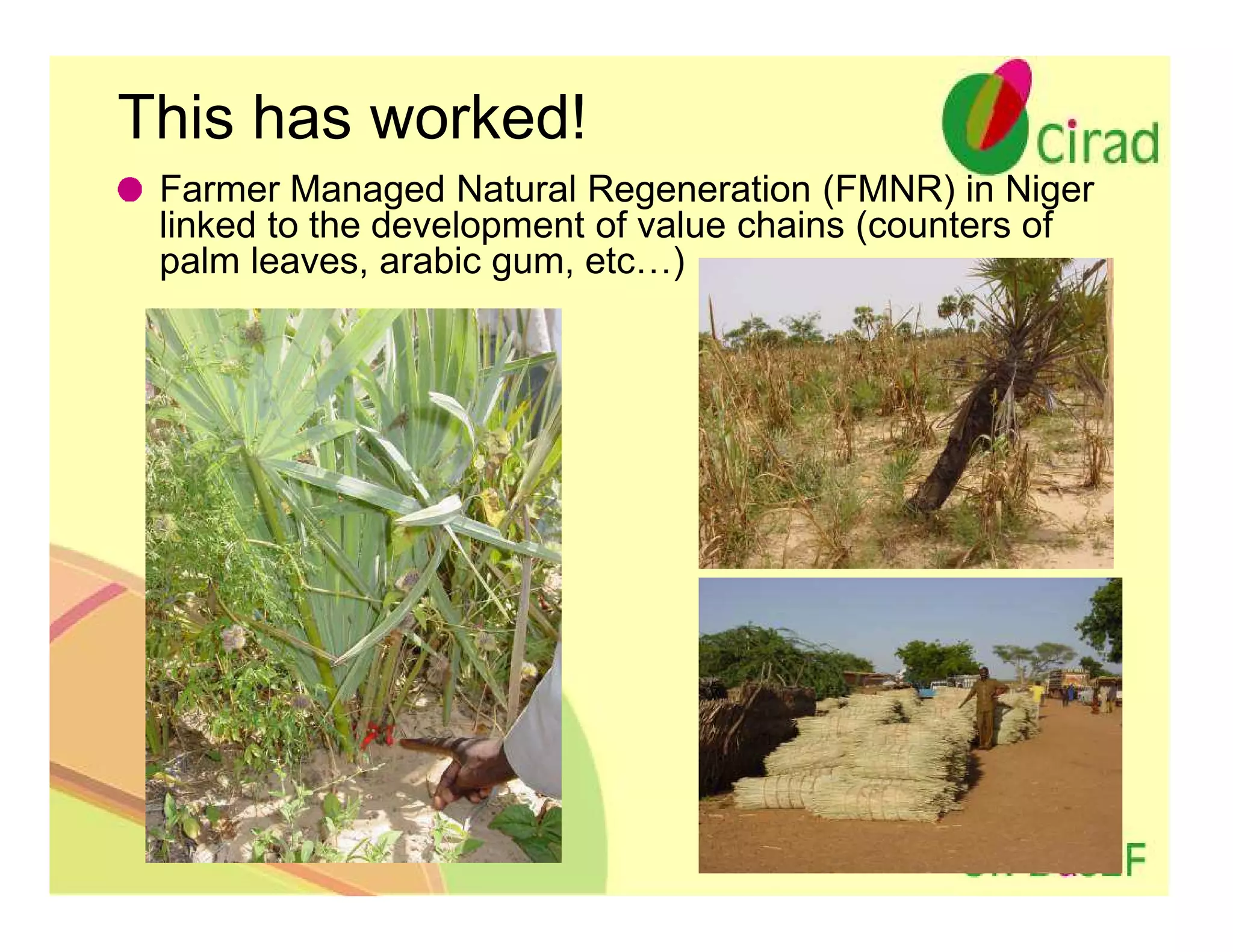
 Farmer Managed Natural Regeneration (FMNR) in Niger
 linked to the development of value chains (counters of
 palm leaves, arabic gum, etc…)
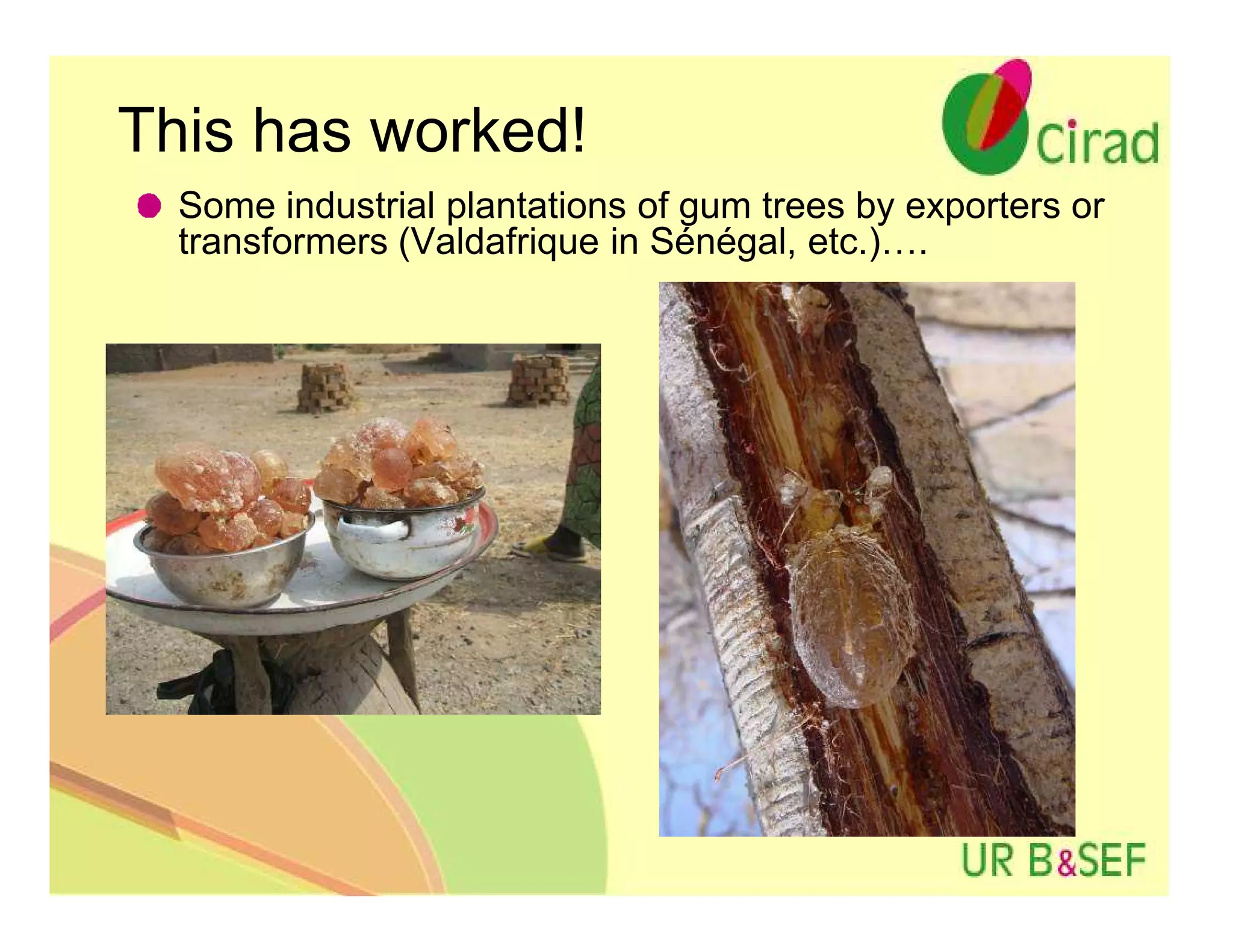
This has worked!
  Some industrial plantations of gum trees by exporters or
  transformers (Valdafrique in Sénégal, etc.)….
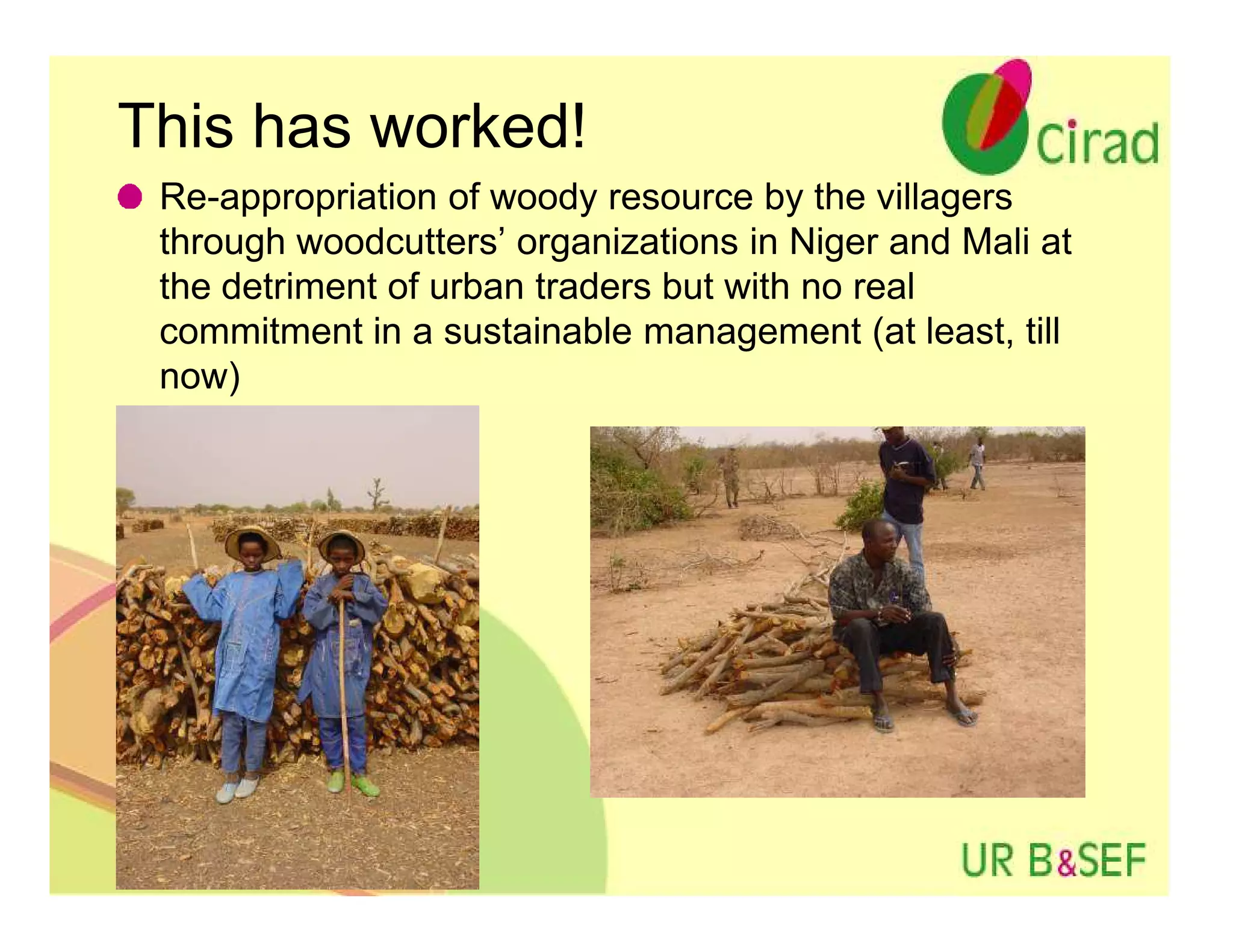
This has worked!
 Re-appropriation of woody resource by the villagers
 through woodcutters’ organizations in Niger and Mali at
 the detriment of urban traders but with no real
 commitment in a sustainable management (at least, till
 now)
Why is this working ?
 When access to land is secured at least
 for the gathering of the forest products
 (which explains that most of the success stories
 are on individual fields)
 When a reliable demand exists for the
 forest products
 When an individual or a social group can
 control all or a part of the forest product
 chain
Why is this working ?
 When the development projects spread an
 innovation with a clear and explicit
 objective
 When the support is done on long-term,
 from plantation to commercialization of
 products
 When a social group is strong enough to
 impose its own rules on competing users
 on the same land; or when a social group
 finds allies instead of competing users
Conclusions
 Reforestation in Sahel is mainly due to individual actions
 linked to well-established chains
 Community forestry is a failure in term of tree
 regeneration in Sahel
    Will privatization of common pool resource help in a context of
    multi-uses and multi-actors, where poor people benefit from
    informal chains ?
    Will the experience of household energy projects that lead local
    people to recapture their territories be followed by an investment
    in forest regeneration in the next 10 years ?
    What will be the benefit from new tools linked to global agendas
    on biodiversity and carbon sequestration :
       an opportunity (tenure clarification and additionality)
       a menace (tenure ‘complexification’, struggles and poor exclusion) ?
Thank you
for your attention!

Promoting tree regeneration in Sahel: Why is it so complicated and where do we go from here

  • 1.
    Promoting tree regenerationin Sahel: why is it so complicated and where do we go from here? Denis Gautier & Régis Peltier
  • 2.
    Land-cover in WestAfrica (« GLC 2000 » – Mayaux 2004)
  • 3.
    Main issues The historyof Sahelian forestry is strongly linked to dramatic environmental and political events The international organizations have used these events to reform the way to manage forests in Sahel Almost 40 years after the first dramatic droughts, forestry paradigms have changed at least three times However, little progress has been registered in terms of forest and tree regeneration, while the wood demand is increasing Have the participative and integrative approach of community forestry failed?
  • 4.
    The co-evolution ofthe environmental and political contexts and the forestry reforms During the colonial period and the first part of the post-colonial period: a centralized, restrictive and coercive forestry 70’s: 1973: first huge drought “Green barrier” to “fight” the desertification State plantations of exotic species with expected high productivity But also: Creation of the CILSS that try to lead the Central administrations to better involve local people in the forest management
  • 5.
    State plantations ofexotic species with expected high productivity
  • 6.
    The co-evolution ofthe environmental and political context and the forestry reforms Early 80’s: From State plantations to village plantations mainly with exotic species (ex: World Bank and ‘village forests’) Experiments of “participative” approaches that use the “forest side population” as labor force (ex: BIT in Kita, Mali but also ‘chantiers’ in Burkina) Mid-80’s Beginning of more integrative and individualistic approaches such as agroforestry or promotion of individual plantations
  • 7.
    80’s : Beginningof more integrative and individualistic approaches such as agroforestry
  • 8.
    The co-evolution ofthe environmental and political context and the forestry reforms End 80’s - Early 90’s: Structural Adjustment plans Less State but not necessarily better State: decreased control on the field and increase of corruption Rural people are seeking more democracy and participative ways of managing forest resources Beginning of a ‘revolution’, which lead people to recapture their bush and to ‘plant the seeds’ of decentralization
  • 9.
    The co-evolution ofthe environmental and political context and the forestry reforms 90’s Launch of decentralization processes Change of paradigm in forestry with the transfer of forest management to local people (+/- within the framework of decentralization) Household energy projects in Mali and in Niger ‘Chantiers’ around the State forests in Burkina ‘community forestry’ in Senegal, Gambia, etc.
  • 10.
    Household energy projectsin Mali and in Niger
  • 11.
    Key scholars inparadigms’ change Thomson’s proposals in 80’s Giving more power to autonomous local government Privatization of tree tenure and common property resource
  • 12.
    Key scholars inparadigms’ change Bertrand et al and Kerkof proposals in mid-80’s Transfer of management authority to local people (professional organizations) Reform of forest fiscal system to promote sustainable management of the commons (differential taxation) Regulation and control of collective property exploitation
  • 13.
    Transfer of managementauthority to local people (professional organizations or decentralized authorities)
  • 14.
    Key scholars inparadigms’ change Ribot’s proposals in 90’s Empowerment of local authorities as a conditionality to sustainable management of ‘la brousse’ Accountability of the involved institutions to empower local democracy
  • 15.
    Few of thesechanges in Sahelian forest paradigms has lead local people to regenerate trees and forests
  • 16.
    Some explanations (1) Technical points: In a multi-purpose landscape, it is not easy to spare a young tree from livestock or ploughshare Some species are not so easy to regenerate outside a forest (or long fallow) “ambiance”
  • 17.
    In a multi-purposelandscape, Not so easy to tree regenerate outside a savanna « ambiance »
  • 18.
    Some explanations (2) Social points: Until farmers and herders perceive resource scarcities and view them as gravely threatening, they manage the forest in a ‘passive’ way Scientists were wrong about the forest resource scarcity in Sahel, and they have maybe discouraged donors Cf Arnold explanation on the importance of parklands and fallows in wood supply Savannas are more resilient than expected
  • 19.
    Some explanations (3) Institutional and Political points: Sahelian officials have inherited and internalized the French colonial administration’s antipathy to non-government sponsored collective action The actual forest administrations ambivalent about resistance to decentralization processes and an attraction for nasty fines
  • 20.
    Some explanations (3’) Institutional and Political points: Local people know the limit of voluntary action in preserving unregulated common property resources and attempt informal privatization People personally know free-riders when investment in resource preservation is promoted The inflation of institutions governing the commons generate power conflicts that are profitable to free-riders
  • 21.
  • 22.
    This has worked! ‘Faidherbia operation’ that aims to encourage farmers to identify and protect the growth of naturally regenerating Faidherbia albida trees in their fields (South Niger, Northern Cameroon)
  • 23.
    This has worked! Tree regeneration on erosion control terrace between individual fields in Northern Cameroon
  • 24.
    This has worked! Individual small scale plantations of eucalypts around soudanian town
  • 25.
    This has worked! Farmer Managed Natural Regeneration (FMNR) in Niger linked to the development of value chains (counters of palm leaves, arabic gum, etc…)
  • 26.
    This has worked! Some industrial plantations of gum trees by exporters or transformers (Valdafrique in Sénégal, etc.)….
  • 27.
    This has worked! Re-appropriation of woody resource by the villagers through woodcutters’ organizations in Niger and Mali at the detriment of urban traders but with no real commitment in a sustainable management (at least, till now)
  • 28.
    Why is thisworking ? When access to land is secured at least for the gathering of the forest products (which explains that most of the success stories are on individual fields) When a reliable demand exists for the forest products When an individual or a social group can control all or a part of the forest product chain
  • 29.
    Why is thisworking ? When the development projects spread an innovation with a clear and explicit objective When the support is done on long-term, from plantation to commercialization of products When a social group is strong enough to impose its own rules on competing users on the same land; or when a social group finds allies instead of competing users
  • 30.
    Conclusions Reforestation inSahel is mainly due to individual actions linked to well-established chains Community forestry is a failure in term of tree regeneration in Sahel Will privatization of common pool resource help in a context of multi-uses and multi-actors, where poor people benefit from informal chains ? Will the experience of household energy projects that lead local people to recapture their territories be followed by an investment in forest regeneration in the next 10 years ? What will be the benefit from new tools linked to global agendas on biodiversity and carbon sequestration : an opportunity (tenure clarification and additionality) a menace (tenure ‘complexification’, struggles and poor exclusion) ?
  • 31.